What are we looking for?
We are excited that you are interested in exploring serving God, Church and community in ordained ministry. God invites us to come as we are first and foremost and so we are looking for you to be yourself and to become increasingly confident in talking about and showing what you think God is asking of you, inviting you to and to express your feelings about that. Thank you for taking the step of faith in offering yourself to explore ordination.
You can find the services for ordination in the Church of England by clicking on this sentence. One of the best ways to find out what is being looked for in someone who might be ordained is to read the service, particularly the parts of it where the Bishop says ‘Deacons/Priests are ordained to….’ and see whether you feel like the things described there feel like what you are excited about or feeling drawn to by God.
To help us explore this, Church of England is looking for certain Qualities (PDF) in those who are exploring Ordination. The Shared Discernment Process is a process we run within the Diocese and which feeds into a two stage national interview process. As part of exploring what God is inviting you to we see what you bring with you now and how you are developing, as well as seeking to listen to God’s leading for you. The exploration of the qualities lies at the heart of the Shared Discernment Process and would involve meeting with Haydon Spenceley as Diocesan Director of Ordinands and other members of the Assistant DDO team. This exploration might involve visiting other churches, experiencing different kinds of service, some reading or writing, or talking to people such as our team of Diocesan Vocations Advisers who can help you in particular ways. Everyone is different, and so everyone’s journey unpacking these qualities is different. The aim is to build up a picture of who you are, and together listen for how the Lord is speaking to you.
How is this assessed?
Once you have explored the Qualities with your (A)DDO, the Discernment Process moves from within the Diocese to the national assessment stage. This consists of:
1. Stage One assessment
This is an online day which involves a series of six short interviews about elements of the qualities. The feedback report from this day enables us to know how your discernment process has developed so far, where it might be helpful to do a little more preparation, or if in fact it might be worth exploring a direction different to ordination.
2. Focused Depth Work and the Assessment of Psychological Wellbeing
The focused depth work and the Assessment of Psychological Wellbeing usually take place after Stage One. These are key and very helpful aspects of the Shared Discernment Process. The focused depth work looks at key areas in a person’s history, temperament, character and self-knowledge seeking to show us where the candidate is already strong and where there is still work to be done. The Assessment of Psychological Wellbeing is a meeting between the candidate and an experienced and trained psychotherapeutic professional who explores elements of your past, present and hoped-for future. This assessment results in a report assessing strengths, experience and areas of potential vulnerability and risk as we prepare you for Stage 2 and potentially training for ordained life and ministry. Both of these tools are designed to increase your self-awareness and confidence, as well as to assure us, and you, that you are on the right path in exploring training for ordination. The before and after of these is carefully held by your (A)DDO alongside you and we will do our utmost for you to feel comfortable, supported and so that you feel able to be yourself throughout and say what needs to be said.
3. Stage Two assessment
This is a two-day residential discernment panel which involves two interviews and some group work with candidates from other dioceses. The report from this panel indicates whether you are ready to proceed to training for ordination and makes a recommendation to the Sponsoring Bishop within the Diocese to that effect.
If the recommendation is that you are ready to train we will celebrate. If the conclusion is that you are not ready, Haydon will want to work carefully with you, your vicar and anyone else who might be helpful to consider other ways in which your gifts can continue to be used. Whether you are recommended or not this is quite a change. To offer yourself to potentially train for ordination can feel like a risk. It can also be very exciting, sometimes both in the same conversation. Whichever way(s) it feels to you, pastoral care, access to support (which can include from the Diocesan Safeguarding Team where appropriate) is key throughout. We want you to be and to feel most wholly yourself and to express the gifts God has given and is growing within you.
Support
Throughout your time in discernment, Haydon (DDO) and the team of Assistant DDO’s will seek to support, encourage and appropriately challenge you. Alongside them, Bishop Alex as Sponsoring Bishop and Bishop Debbie as Diocesan Bishop are both extremely supportive of new ministry and enabling people to seek to serve God, Church and community as well, faithfully and joyfully as possible.
We are aware that discernment can be exciting and we hope it will be life-giving. The process can also be lengthy, and as you will have observed from this page, there is a need for you as a candidate to talk openly and honestly. This can raise difficult things, sometimes things which you have never explored, or have not for some time. The Diocesan Safeguarding Team are one of several groups who are available to be alongside you should it be needed. There are other ways in which pastoral and sometimes therapeutic support can be sourced if that is helpful to you. If in reading this page you have thought that exploring God’s invitation feels too heavy, don’t let this put you off. We are experienced at hearing people’s stories and seeing what God has built from what can sometimes be difficult circumstances into beautiful present times and hope-filled futures.
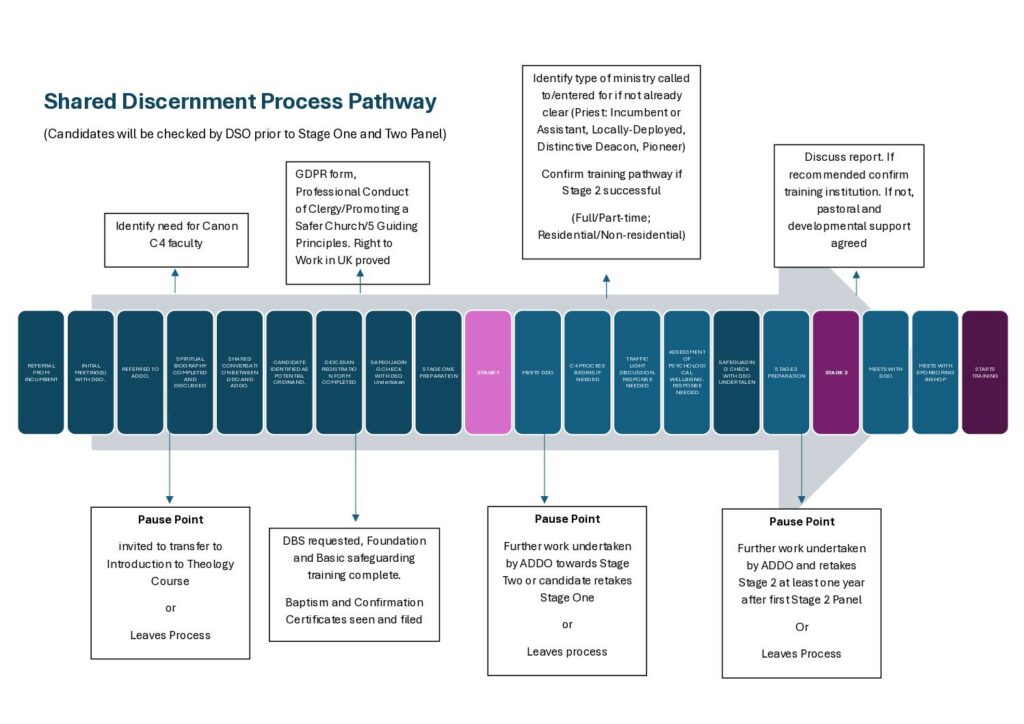
An Outline of the Process
An outline of the Discernment Process within the Diocese can be found below
What about Training?
Training can take various forms and usually lasts two or three years. You can train:
- residentially in a college – there are a variety all over the country to choose from
on a course, which you can undertake alongside your present occupation, and without having to move home
- by studying part-time whilst working part-time in a church.
We consider carefully which route is best for different candidates at different stages in their life. The decision for training pathway and destination is a shared one between you, your family and the Diocese.
All tuition fees are paid for by the Church. There is a system of financial support and grants for those who are in training which your (A)DDO will explore with you at the appropriate time.
A page on the Church of England website detailing different Theological Education Institutions (TEIs) and pathways to training for ordination can be found here: Training Routes: The Church of England